Bring Out How the Play Uses Commedia Dellã¢ââ¢arte to Probe the Threats of Totalitarianism
What is Commedia dell'Arte?
Commedia dell'Arte is an Italian Renaissance form that is best known as a style that features characters wearing half masks, of which there are many, simply there are too many characters within Commedia dell'Arte that practice not wearable masks. Famous characters, such equally Harlequin, Pantaloon, Punch and Pierrot take survived across the generations, being assimilated into art, literature, music, opera and film. Translated to English, Commedia dell'Arte means the 'Professional Comedy' and the actors of this genre were indeed the commencement to be officially recognised as professionals.
Comedy needs an audience and the Commedia troupes would perform anywhere an audience could be gathered; in the early on days this was in piazzas on raised trestle stages with a simple properties, playing to bustling market squares populated by all mode of guild. And then pop were these performances, that the troupes were presently beingness invited into the courts of the aristocracy. The Renaissance witnessed a huge surge in creative creativity, discovery and invention, all of which fed the imagination and narratives of the Commedia dell'Arte. Operation troupes emerged in multiple regions of Italy and they began travelling, conveying the genre into Europe and to Russia. Commedia dell'Arte grew to become one of the most influential and enduring theatre styles in the world. The 17th century was theGolden Era for Commedia dell'Arte every bit Italian comics dominated the European stage and the star arrangement was born, firmly establishing acting as a legitimate merchandise. Commedia began to exist replicated in cities across Europe and famous Italian troupes travelled on invitations to Royal Courts, such as that of Louis Xiv, who was a swell advocate of the arts.
"Shakespeare, Ben Jonson, Molière, Marivaux, Beaumarchais, Goldoni … Wherever there are witty servants and domineering masters, young wives and old husbands, pompous pedants, thwarted lovers or bragging soldiers, the Commedia is at that place in spirit and also very oft grade"

Did you know?
-
The term 'commedia dell'arte' was never used during the 16th and 17th century to describe the form - it was Carlo Goldoni who coined the phrase in his play The Comic Theatre in 1750 in a somewhat derogatory manner.
-
Opposite to popular belief, commedia dell'arte was not all improvised - many aspects were thoroughly apposite and sure speeches were written.
-
The start documented advent of a woman on stage was by extra Vincenza Armani in effectually 1566 but the nigh famous First Actress was Isabella Andreini, wife of Francesco Andreini of Il Gelosi, first appearing on stage in 1576.
-
Shakespeare took direct inspiration from commedia dell'arte for many of his plays. Shakespeare's Fools are often zanni character types; his romantic leads are conspicuously inspired past Commedia's innamorati (the Lovers), his miserable erstwhile misers past Pantalone and his pedantic, buffoon-like old men by il Dottore.
-
From around 1770 to 1900,Harlequin (Arlecchino) was the star of the English language Harlequinade, along with Columbine and Pantaloon. This later evolved into Pantomime.

Origins of Commedia dell'Arte
The roots of many characters and plots can be traced back to Roman comedies and fifty-fifty farther to Atellan farces (Fabulae Atellanae that appointment from around 300BC; these rustic farces were so called as they originated from Atella in Italy). The Atellan farces brought forth stock characters: the fool, the trickster, the glutton, the erstwhile human … the links to Commedia are undeniable.
Commedia began to accept its populist form in the 15th-16th centuries and most probable came about as an evolution of funfair and the rustic street giullare (itinerant satirical storytelling jesters). It is probable that the early performers of commedia zannesca were tradesmen who banded together through local guilds as a post-work form of entertainment. The theatrical style evolved during the 16th century, existence varyingly known every bit commedia all'improvviso (improvised comedy), commedia delle maschere (comedy of the masks) commedia zannesca (zanni one-act) or fifty-fifty commedia mercenaria (mercenary one-act). 1545 is credited as being the official nascency of commedia, celebrated internationally by commedia enthusiasts on 25th Feb.
"On Midweek Feb 25th 1545 and extraordinary result took place.
A grouping of Professional comedians: Vincenzo da Venezia, Francesco de la lira, Hieronimo da San Luca, Giandomenico also known as il Rizo, Giovanni da Treviso, Tòfano de Bastian, headed by a ser Maphio del Re, known as Zanino da Padova, appeared in front the notary Vincenzo Fortuna, in the San Leonardo quarter to put downward on notarial paper the formation of a Professional Company of Comedians. It was the birth from scratch of the modernistic Theatrical Company." Tonino Pavan's dedication message for Commedia dell'Arte Day 2021
This legitimate fraternal compagnia paved the way for acting as a recognised profession. Commedia dell'arte was only anointed as such, retrospectively and well after the form had reached mass popularity throughout Europe. It was playwright Carlo Goldoni who, in 1750, wrote rather disparagingly of the actors of the course in his play Il Teatro Comico, referring to it as Commedia dell'Arte.

Early Commedia dell'Arte
At outset, performances by commedia troupes took place wherever an audience and some form of stage could be found - indoors or out, commonly performed in piazzas, on a 2 metre high trestle phase, with a single backdrop. That backdrop evolved with the players to depict a house or a row of houses on a street, oftentimes with openings as windows. Commedia performances gained popularity apace and the actors saw an opportunity to make profit. They began to sell seats at their performances and the troupes were before long invited to perform in courts and palaces of Dukes and Royalty. Performing groups emerged in different regions of Italian republic with some character names changing accordingly. It is thought that the characters may well have lampooned familiar locals and almost certainly narratives would have been altered to make local references. The troupes travelled throughout Italy and into Europe arriving in French republic, Espana, Germany, England and Russia past the end of the 16th century. The development of a linguistic communication of all languages, grummelot, aided the actors to exist understood wherever they went. Grummelot being a gibberish language that uses the paralinguistics of a language - the intonation, rhythm and musicality - to mimic the local dialect, aided by physical antics and bold gestures to exist understood.
Very few theatres had been built since Roman times but in 1588, the architect Vincenzo Scamozzi began buildingTeatro all'Antica in Sabbioneta, Northern Italian republic as an indoor playing infinite for Commedia, based on the designs of Roman amphitheatres. Concepts of perspective were beginning to exist explored during the Renaissance and the first perspective backdrops were created, depicting street scenes. Teatro all'Antica was the first theatre in mod times that was conceived from the start equally theatre building and nevertheless stands today as a UNESCO Earth Heritage site.

Comedy of the Masks
The plays (scenarii) themselves were devised effectually a loose storyline (canovaccio), featuring fast-paced activeness, slapstick sequences and simple disharmonize-driven narratives (frequently focused on beloved, greed, illness, injustice, starvation). Actors traditionally performed without scripts, relying on a running order (canovaccio) to determine the narrative flow but each actor would have a repertoire for their character that may include apposite lazzi (comic physical gags), concetti (romantic poetic verse) or other monologues they could comprise into the action. Each character had a distinct repertoire of moves and stances that would have been adult and mastered by an histrion over many years of playing the same role.
Masks, props, acrobatics, songs, trip the light fantastic toe and music were key features of this comic style, known past many different names. The earliest forms of commedia (commedia zannesca) are idea to have featured merelyzanni characters: the archetypal fool; the peasants who have come to the cities to try to find work. Their thought processes were simplistic, governed by physical and carnal needs for survival. For the grapheme ofzanni, the actor wore a mask, frequently with a long nose (it is idea that the longer the nose, the more dim-witted the character). Masks existed for female zanni types (zagna) worn by men, affording the opportunity for crude sense of humour. It is likely that these masked performances were an evolution from the 'vulgar one-act' of festivals such as the Feast of Fools and the Feast of the Ass. The comedy of these early plays relied on crass, often violent humour, driven by lecherous needs of thezanni.
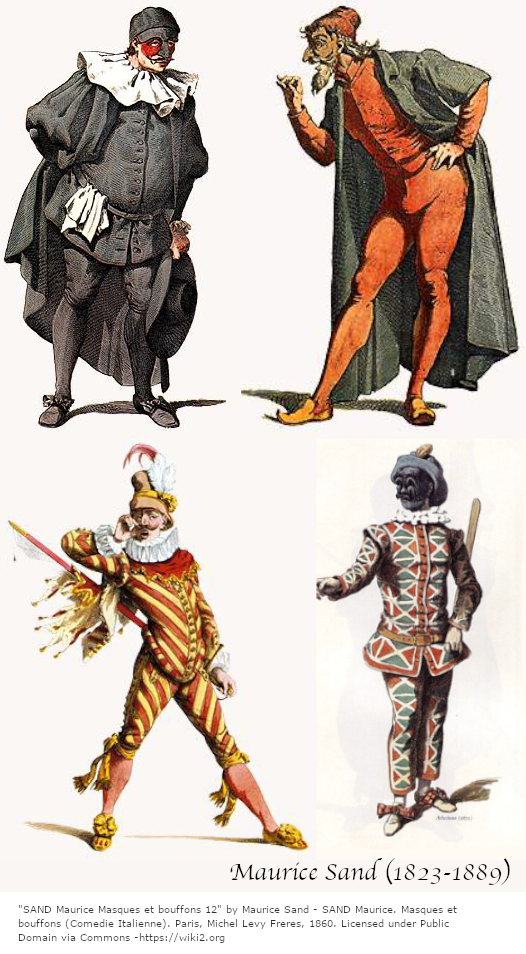
The Stock Characters
Characters appeared in response to the social strata of the times and as need arose, with the actors gradually increasing the complexity of the narratives. There are literally hundreds of character variations but it is generally recognised that there are a scattering of stock character types that always appear in the plays. Zanni is one such stock character type that is a collective term for all the low ranking servants of commedia, including Arlecchino (Harlequin), Columbina, Brighella and Pulchinella.
IlVecchi ('the old men') joined the ranks of commedia, as a stock type that lampooned the wealthy, powerful landowners of Renaissance Italian republic. Pantalone is one such money-hungry boss who appeared in the productions past Venetian players. He became a chief for the zanni; someone to be mocked past the underdog. The origins of Pantalone tin can exist charted back to The Old Miser who featured in the Roman plays of Plautus. He is about likely based on the merchants that traded gilt and lent money in Venice. The lynch-pivot of the merchant class at this time was the - so - much despised Jewish customs. Pantalone's mask commonly bears a hook olfactory organ, wrinkled lines and pursed lips and is typically played equally an one-time, arthritic man who wrings his hands and protects his handbag at all costs.
Another il Vecchi character is Il Dottore (The Medico). He is a quack who is a self-proclaimed expert on whatsoever discipline he so chooses - frequently medicine or law - depending on what the storyline requires. Information technology is probable he was inspired by the charlatans who pedalled their wares in the 16th century market place places, proffering obscure 'cure-alls', potions and ointments. His is a quarter mask, roofing olfactory organ and brow assuasive the role player greater freedom in the cheeks to speak with clarity and be seen equally 'human'. Il Dottore is a great orator who loves the sound of his own voice and may have well-rehearsed speeches (sproloquio) to be pulled out to concord an audition's attending when comprehend is needed for a costume or scene change.
Il Capitano was introduced every bit some other stock character; a stranger from out of town, commonly a armed forces man from Spain, who boasts of battles and victories. This character is i that derives directly from Roman plays whereThe Braggard was a familiar fop who told alpine stories and arrogantly strutted well-nigh the phase (Plautus' Miles Gloriosus written in around 205BC). In commedia,il Capitano is commonly a sword-brandishing, show-off, just also oft a coward when faced with danger or confrontation. Numerous variations of Il Capitano can exist plant in commedia scenarios - sometimes he is masked, sometimes unmasked; sometimes he is an incompetent phoney, sometimes a wealthy and eligible suitor.

Women on the stage
A fundamental moment in theatrical history took place in the 1560's when women entered the stage. There is evidence of female zanni roles (zagna) from the earliest documented commedia scenarios merely it is thought that these were played by men in masks. Information technology was the famousGelosi troupe who began a revolution in theatre by formally introducing an actress, unmasked, as a loftier class 1st Actress known as Innamorata :the Lover. Actresses may well accept played zanni characters - servetta - before this fourth dimension, simply once again, it was not until Columbina (ever unmasked) emerged, that evidence of women on stage tin be confirmed. The arrival of women on stage caused a sensation with shock and gossip, attracting voyeurs as well as considerable criticism, but the outcome was a surge in popularity for Commedia dell'Arte and theprima donna was built-in. The female person Lover was soon paired with an unmasked male Lover. These characters appeared equally the children of the Old Men:il vecchi (Pantalone andDottore) and enabled storylines to take on new depth and complexity.
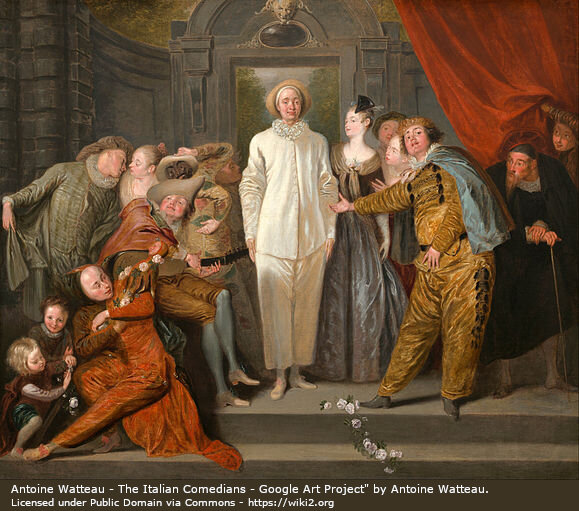
Golden Era
The 17th century was theGold Era for Commedia dell'Arte equally Italian comics dominated the European stage and the star system was born, firmly establishing acting equally a legitimate trade. Popularcommediacompanies began traveling throughout Europe, performing almost notably in Spain, England, Germany and in France, where the grade became known as laComédie-Italienne to differentiate it from la Comédie-Française. Louis Xiv was a swell supporter of the arts and he invited a Commedia dell'Arte troupe to perform regularly at his court, until they mocked his mistress, Madame Maintenon, and he banned them from performing. It was in the court of Louis Fourteen that Jean-Baptiste Poquelin (Molière) discovered Commedia dell'Arte.
Meanwhile, in England, it is very likely that Shakespeare would have seen or at to the lowest degree heard accounts of the Italian Players and the influence of Commedia is conspicuously visible in many of Shakespeare's works. In the early 18th Century, the Harlequinade came into vogue featuring Harlequin,Columbine,Pantaloon, The Helm, Polchinelle and Pierrot. This was the forerunner of the Victorian Pantomime.

Classic One-act
The influence of Commedia dell'Arte can exist traced throughout the history of comedy. Every classic comedy that has stood the exam of fourth dimension is indebted to Commedia dell'Arte for hilarious, comic character types and physical slapstick and tomfoolery.
"…the lean and slipper'd pantaloon,
With spectacles on olfactory organ, and pouch on side…"
The wonderfully heightened, archetypal characters appear in many classical works, especially evident in those of Shakespeare and Molière. Some of Shakespeare's narratives bear hit resemblance to the writings of Ruzante and Flaminio Scala. Without doubt, Shakespeare had heard nigh the Italian players - references in several plays explicitly evidence this knowledge. Information technology is highly likely that he fifty-fifty saw them perform, as the Italian troupes were travelling throughout Europe and known to have been performing in London by the tardily 16th century.
From the stage to the screen, to music, opera and art, Commedia has been kept alive and has evolved to become one of the almost important and versatile fine art forms in history.
The evolution continues.
Robert Henke, Professor of Drama and Comparative Literature & Director of Graduate Studies, Yard.A. in Operation Studies at Washington University in St Louis, and author of several books and articles on the connections between Shakespeare and the Italian Comedies, offers some insight into the connections in this interview, on the podcast Hold That Idea:
"The virtually popular entertainments of the first role of the 20th century … seem closely related to the Commedia. Indeed it is hard to conjure images of the Commedia without seeing Charlie Chaplin, Due west.C. Fields, Bert Lahr, The Marx Brothers … or Laurel and Hardy"
There has been a drive for much of this century to get Commedia dell'Arte recognised by UNESCO. An clan of Commedia practitioners, Sat, was fix in 2005 forth with an online archive to manage, archive and preserve heritage relating to Commedia: http://www.incommedia.org This film was made in an entreatment to the UNESCO committee to go Commedia dell'Arte listed officially equally Intangible Cultural Heritage. If it doesn't play click here to view the motion-picture show
"… everywhere you get, it is acknowledged as the foundations upon which modern theatre was built." Aldo Giuponi, talking on UNESCO entreatment for Commedia dell'Arte video by Enzo Aronica & Luciano Brogi (2005)
"It of import that nosotros remember that Commedia dell'Arte was ane of the primordial moments of interrelation among diverse nations" Ferruccio Marotti, talking on UNESCO appeal for Commedia dell'Arte video by Enzo Aronica & Luciano Brogi (2005)
Useful further reading:
Cheryl has collected useful Commedia dell'Arte reference books into a Google Books Library. Y'all tin can access this by clicking here. If y'all discover problems accessing this or take questions you would similar to ask, exercise drop usa an e-mail by clicking here.
Source: https://learningthroughtheatre.co.uk/commedia
0 Response to "Bring Out How the Play Uses Commedia Dellã¢ââ¢arte to Probe the Threats of Totalitarianism"
Post a Comment